


Thermal Imaging
What Is Thermal Imaging?
Thermal imaging—also called infrared imaging, thermography, or thermal scanning—uses an infrared camera to detect heat patterns that are not visible to the human eye. In a marine survey, this non-invasive technology can help identify temperature differences that may indicate conditions requiring closer evaluation.
Thermal Imaging During a Sea Trial
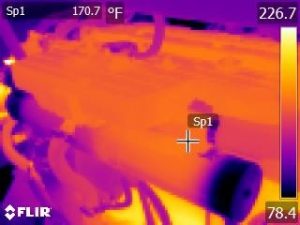
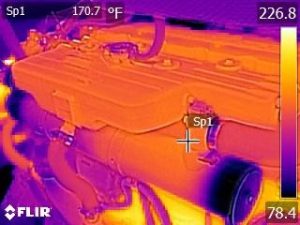
The two images below show a Cummins diesel marine engine operating during a sea trial. The image on the left is a standard thermal image. The image on the right uses FLIR MSX® technology, which combines thermal information with visible-light detail to make components, labels, and surrounding features easier to identify.
Thermal Hull Imaging
The images below compare a standard hull thermal image with an MSX-enhanced image. The added visual detail can help the surveyor identify the precise area represented in the thermal image and document findings more clearly.
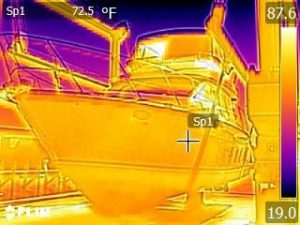
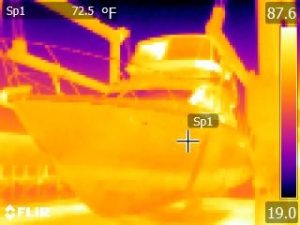
MSX® technology helps produce a more defined image by retaining visible structural details within the thermal view. This can make it easier to locate and document areas that may need additional attention.
How Does Thermal Imaging Help During a Marine Survey?
Marine surveys are primarily non-destructive. In most cases, a surveyor does not dismantle engines, electrical panels, pumps, exhaust components, or other vessel systems simply to inspect what is inside. Thermal imaging provides an additional method for observing operating equipment and identifying unusual heat patterns without taking components apart.
Depending on the vessel, equipment access, and operating conditions, thermal imaging may help identify temperature variations associated with electrical connections, engine components, exhaust systems, cooling systems, bearings, tanks, and portions of the hull or deck. These variations do not automatically mean a defect exists, but they can point to areas that deserve closer examination or evaluation by a qualified marine mechanic or electrician.
For example, an unusually warm electrical connection may warrant further electrical inspection. A temperature difference in an engine cooling component, exhaust manifold, or heat exchanger may suggest that additional mechanical evaluation is appropriate. Thermal imaging helps us identify concerns efficiently and document them as part of the survey process.
How Marine Thermal Imaging Works
Every object emits infrared energy in the form of heat. A thermal camera detects that energy and displays it as a visual image showing relative temperature differences. Unlike ordinary cameras, a thermal camera can operate in darkness because it detects infrared radiation rather than visible light.
Thermal imaging is widely used in industrial maintenance, electrical inspections, building evaluations, and other applications where temperature patterns can reveal conditions that are not obvious through a visual inspection. During a marine survey, it is an additional tool used with traditional inspection methods—not a replacement for them.
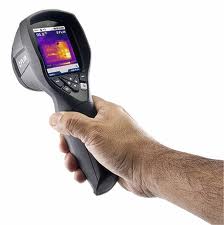
We use professional FLIR® infrared cameras with MSX® Thermal Image Enhancement where appropriate. MSX technology combines visible-light detail with the infrared image, helping preserve identifying features such as component edges, labels, and markings. The result is a thermal image that is easier to understand and more useful when documenting areas of interest.
Each image may be reviewed in different formats, including:
- Digital image: A standard visible-light photograph.
- Thermal image: An infrared view showing temperature differences.
- Thermal MSX image: A thermal image enhanced with visible-light detail to help identify the exact component or area shown.
Benefits of Thermal Imaging for Boat Buyers
Thermal imaging provides an added level of information during a marine survey, particularly when engines and systems can be observed under normal operating conditions. Potential benefits include:
- Non-contact inspection. Thermal imaging allows us to observe operating engines, machinery, and electrical components without touching hot, moving, or energized parts.
- Real-time observations. Temperature patterns can be viewed and documented while engines, generators, air-conditioning systems, and other equipment are running.
- Efficient identification of areas needing attention. A thermal image may help focus further inspection on a specific component, connection, or section of the vessel.
- More complete survey documentation. Thermal images can be included in the marine survey report when they support relevant findings or recommendations.
Thermography and Vessel Safety
Thermal imaging can help identify conditions that may affect the safety, reliability, or value of a vessel. Examples can include unusual heat at electrical connections, abnormal engine or exhaust temperatures, cooling-system irregularities, and thermal patterns that may warrant further investigation in fiberglass structures.
It is important to understand that thermal imaging does not guarantee that a vessel is free from defects, and a temperature variation alone does not establish the cause of a problem. Findings are evaluated together with the visual inspection, moisture readings, percussion soundings, sea-trial observations, maintenance records, and any recommended specialist inspections.
At Sun Coast Marine Surveying & Consulting, thermal imaging is used as part of a thorough, modern marine survey process. It complements proven survey methods and helps provide buyers with clearer information before they make a purchase decision.
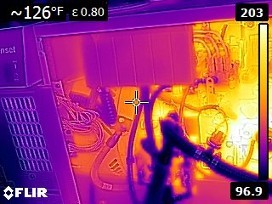
Thermal image of an onboard generator operating under load.
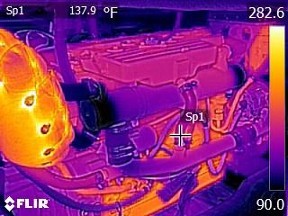
Thermal image of a Cummins diesel marine engine.
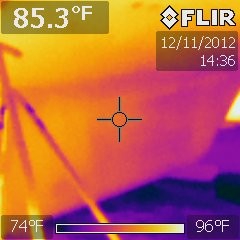
Infrared thermal image showing a possible area of hull delamination toward the lower-right portion of the image.
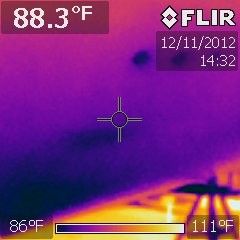
Infrared thermal image of a fiberglass hull bottom showing an area requiring further evaluation.